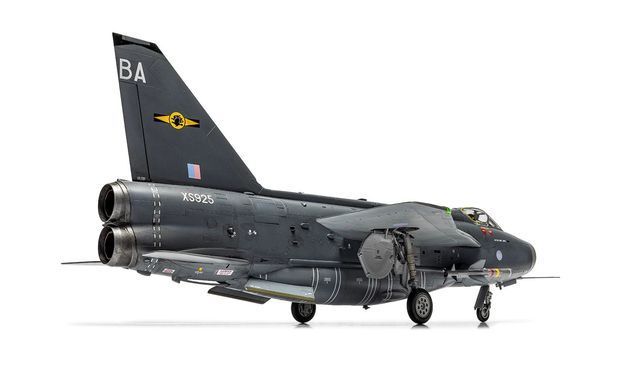
The Electric Lightning is a British twin-engine supersonic fighter. The F.1 version flew in 1960, and the F.2 four years later. The Lightning is characterized by an unusual arrangement of engines - vertically one above the other. Also unique is the very unusual wing contour and the absence of flaps. It was equipped with two Rolls-Royce Avon 302 engines with a capacity of 7260 daN with afterburner. The prototype of the serial Lightning was a machine with the designation P.1B. Since 1960, that is, shortly after the final version was taken into the air, the machine began to be supplied to the Royal Air Force squadrons. A total of 338 machines of this type were created in six different versions (interceptor - F.1 and F.1A, fighter-bomber - F.53 and combat trainer - T.4, T.5, T.55). The aircraft failed to attract any European buyers, but was exported to Kuwait and Saudi Arabia. The Royal Air Force Lightning units were produced in the 1980s. These aircraft were equipped with a Ferranti AI Mk 23 Aispass radar, and the main armament was Firestreak or Red Top air-to-air missiles with an IR system and two 30 mm cannons. Technical data: Maximum speed: 2415 km/h, rate of climb: 254 m/s, maximum ceiling 12200 m, maximum range: 1290 km, armament: stationary - 2 30 mm ADEN cannons, overhead - 2720 kg of bombs and missiles.