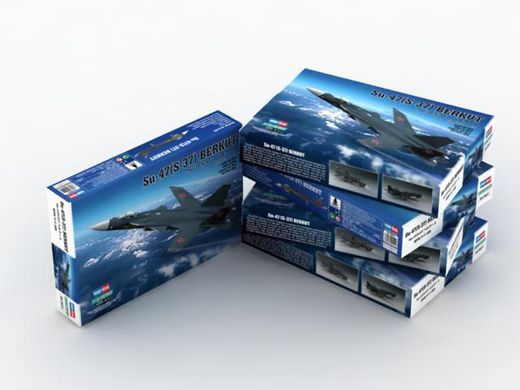
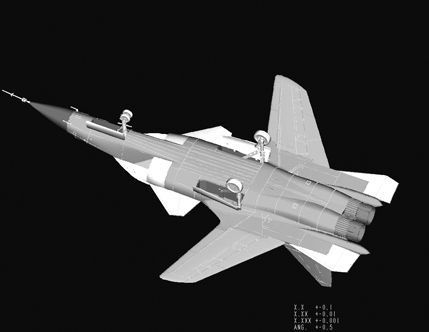
The Sukhoi S-47 Berkut is an experimental Russian fighter-interceptor with a composite structure and a very rare negative wing sweep. It is powered by two Solovyov D-30F6 turbojet engines. The prototype first flew in September 1997. To date, only four examples of this aircraft have been built. The aircraft has no fixed armament.
Work on the Sukhoi S-47 began in the early 1980s and was aimed at creating a far-reaching modernization of the very successful Su-27 aircraft. After numerous turbulences and suspensions of the project due to financial problems, Sukhoi decided to complete the project independently and in 1999 presented the finished aircraft. The aircraft, however, was not intended for mass production, but rather became a technology demonstrator. First of all, the machine is distinguished by a negative wing sweep angle, which has many advantages, in particular: it provides better maneuverability at speeds of about 1 million km/h, and also allows you to reduce fuel consumption. It also uses new composites, which make up approximately 15% of the materials from which the S-47 is made. The armament was placed in an internal chamber, which was also rare in other Soviet fighters. An electric remote control system for the aircraft was also introduced. Although the S-47 did not enter mass production, it allowed Sukhoi to accumulate valuable experience that was used in the Su-35 aircraft and in the development of the Russian 5th generation fighter - PAK-FA.