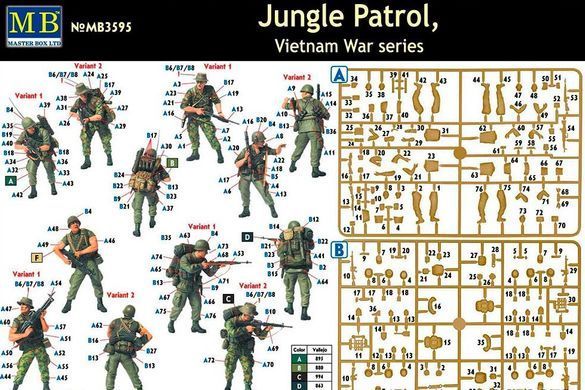
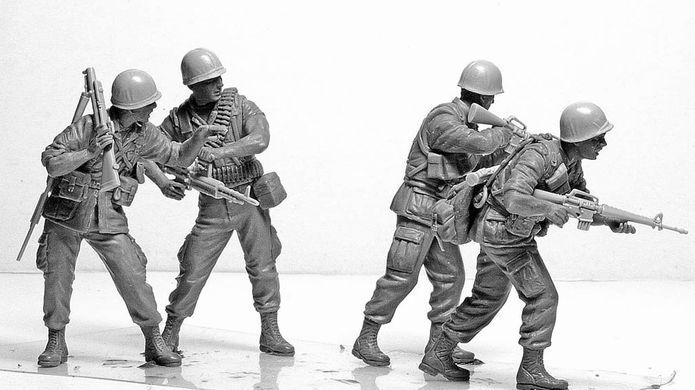
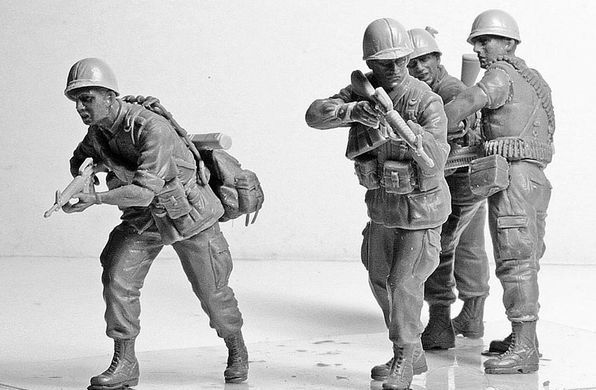
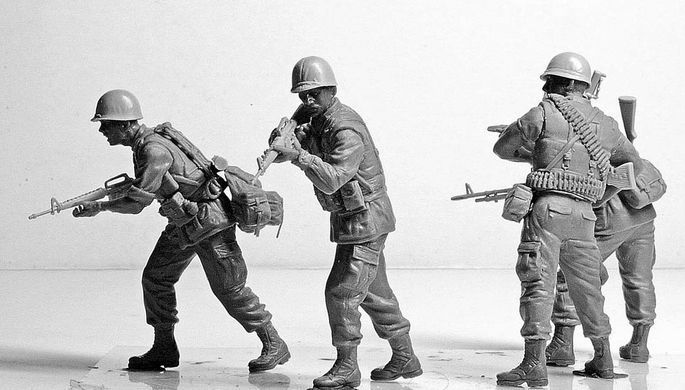
The Vietnam War (1964/1965-1975) was a conflict between the government of South Vietnam, which was heavily (economically, politically, militarily) supported by the United States, and North Vietnam, which was supported by the USSR and the PRC. Due to the very difficult terrain in Vietnam (jungles, numerous watercourses and canals, hills), the main type of armed forces quickly became infantry, especially light infantry with high mobility and air mobility. The main small arms weapon of the American infantryman in Vietnam was initially the 7.62 mm M14 semi-automatic rifle. However, already in 1964, the 5.56 mm M16 automatic carbine (initially the XM16E1) was experimentally introduced, which became the main weapon of the US infantry from 1966, and from 1967, improved M16 A1 models began to be supplied. The weapon, especially in the initial production batches, was not fully developed, and in addition, it required very thorough cleaning, was very prone to contamination and jammed easily. In addition, 40 mm M79 grenade launchers were used. M72 and M72A1 LAW rockets were rarely used. On the other hand, Browning M2 heavy machine guns and M60 heavy machine guns were used on a large scale. During the Vietnam War, the platoon turned out to be the main tactical unit of the US infantry. Its structure in linear, light and airborne infantry was almost identical. The platoon consisted of a headquarters led by a lieutenant or second lieutenant and a unit to which an artillery observer, a paramedic and a radio operator were assigned. Its main force was three rifle groups of 10 soldiers each. In addition, there was a heavy weapons team with two M60 Rkm guns and two M67 recoilless guns. It is worth adding that the above organization was a regular one, and in the realities of war, regular work often differed from the realities of the battlefield.