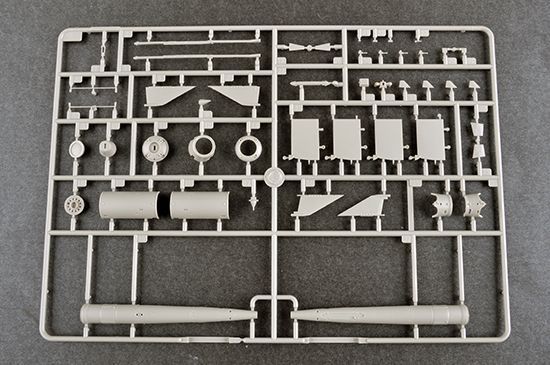
The S-75 Daugava (NATO reporting name: SA-2 Guideline) was a Soviet anti-aircraft missile system of the Cold War era, designed to destroy medium and high-altitude targets. The SA-2 was a two-stage missile with a range of up to 45 kilometers, capable of carrying a warhead weighing up to 200 kilograms and destroying targets at altitudes of up to 25,000 meters.
In the early 1950s, the US Air Force began to intensively develop its fleet of strategic bombers (B-47, and later B-52), which were to deliver nuclear strikes on the territory of the USSR. This fact led to the Soviet Union starting work on a new anti-aircraft missile in 1953, which finally became the SA-2. It was first presented to the public in 1957. It was probably in the same year that the SA-2 began to be introduced into the anti-aircraft units of the Soviet Army. At the time of its introduction, the system had high combat capabilities and turned out to be an unpleasant surprise for the US Air Force. It proved its capabilities in 1960, when an SA-2 missile shot down a U-2 plane piloted by Francis Powers. This weapon was also sold by the USSR to North Vietnam and effectively limited the freedom of operation of American aircraft during the Vietnam War (1964/1965-1975). Later, many modernizations of the systems were introduced, the most important of which is the S-75M "Volkhov" (NATO reporting name: SA-2C) with significantly higher parameters, shorter response times and better guidance systems. SA-2 missiles were exported to many countries, including Bulgaria, Czechoslovakia, Egypt, Moldova, Poland and Romania. They have also participated in many armed conflicts. In addition to the aforementioned Vietnam War, they have participated, for example, in the Six-Day War (1967), the Indo-Pakistani Wars of 1965 and 1971, the Yom Kippur War (1973), and the Iran-Iraq War (1980-1988).