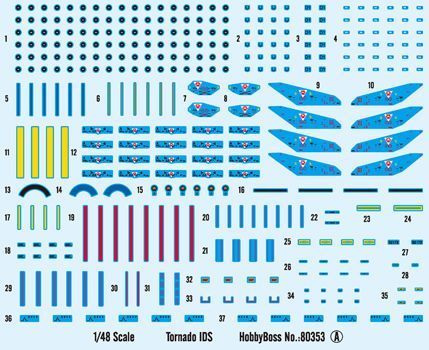
The origins of the Tornado design date back to 1968. It was then that the tri-national PANAVIA consortium was formed to implement the project known as the MRCA (Multi-Role Combat Aircraft). On 14 September 1974, the first prototype flew and construction of the first 640 aircraft ordered began, with production divided so that Germany and the United Kingdom each completed 42.5% and Italy 15% of the order. The Tornado fleet is now the most important part of the air forces of the three European NATO countries. They remain in service with the air forces of the United Kingdom (Royal Air Force), Italy (Aeronautica Militare Italiana) and Germany (Luftwaffe), as well as with the German Navy (Marinefliege). In addition, in 1986, a number of these aircraft were ordered by Saudi Arabia and incorporated into its armed forces (Royal Saudi Arabian Air Force). There are three main versions of the aircraft: the Tornado ECR, the Tornado ADV and the Tornado IDS. The Tornado ECR is a German-Italian reconnaissance version, it can carry Raytheon AGM-88 HARM anti-radar missiles. In addition, they carry AIM-9L Sidewinder missiles for self-defense. The Tornado ADV is an interceptor version, equipped with an excellent Marconi-Ferranti Foxhunter radar with a range of up to 190 km and capable of tracking up to 20 targets simultaneously. The Tornado IDS, on the other hand, is an attack bomber, designed primarily to support ground forces. It is capable of carrying a very wide range of weapons, including: the CWS flying cartridge, Paveway II guided bombs, GBU-15 guided bombs, AGM-65 Maverick air-to-surface missiles. Technical data (ADV version): length: 18.68 m, wingspan (maximum): 13.91 m, height: 5.95 m, maximum speed: 2.27 million km, rate of climb: 77 m/s, practical ceiling: 21,300 m, maximum flight range: 1,850 km, armament: stationary - one 27 mm IWKA-Mauser cannon, suspended - up to 8,500 kg of cargo.