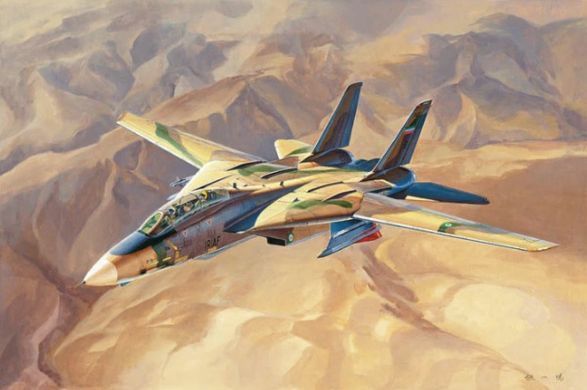
Designed as the primary fighter for the US Navy, the F-14 Tomcat was capable of air superiority, escort and strike missions and was undoubtedly one of the most complex and technologically advanced aircraft ever to serve on aircraft carriers. The prototype took to the air on 21 December 1970, and the first aircraft were delivered to the US Navy four years later. The last Tomcat aircraft were decommissioned only in 2006, which perfectly illustrates the high quality and excellent characteristics of this machine. The most innovative and characteristic solution for the F-14 is the variable geometry wings. Controlled by a computer or manually by the pilot, they can change the angle of attack from 20 degrees at minimum speed to 60 degrees at supersonic speed. The variable geometry of the wings also allows for optimal wing positioning during tight maneuvering, thanks to which this powerful aircraft demonstrates amazing maneuverability. The heart of the Tomcat's weapons system is the Hughes ANG-9 radar, which usually interacts with the AIM-54A Phoenix air-to-air missiles with a range of up to 180 km. The ability to track and attack more than one target is particularly important. An equally important element of the armament, as combat experience in the Vietnam War has shown, is the cannon - the F-14 has an M-61 "Vulcan" installed inside the hull, which fires up to 6,000 rounds per minute! Of course, other types of weapons can be attached to the Tomcat, such as Sparrow, Sidewinder missiles or various bombs. The F-14 also owes its success to its excellent power plant in the form of a pair of Pratt-Whitney TF30 engines with a thrust of 9,300 daN on the afterburner. Technical data: Maximum speed: 2480 km/h, climb rate: 153 m/s, practical ceiling 17100 m, maximum range: 3200 km, armament: stationary - single, six-barreled 20-mm M61-A1 cannon, outboard - up to 6.