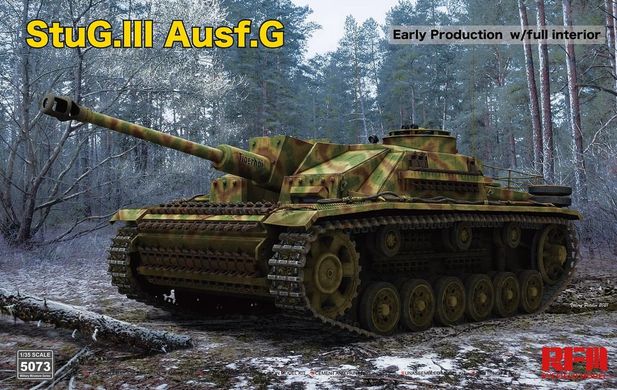
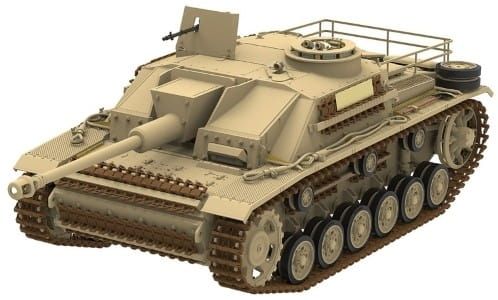
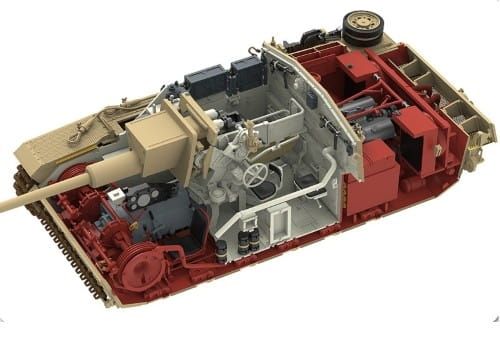
Assembled model 1/35 tank destroyer StuG III Ausf. G with full interior Rye Field Model RM-5073 And it continues with the kits for the StuG III, with Rayfield also involved - but here we have a complete interior kit and it's worth a closer look. So, let's take a look at the box:
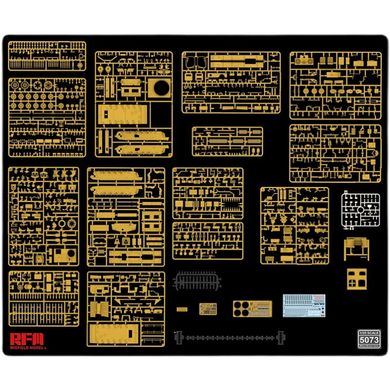
here we find 15 beige sprues, 216 chain links in the sprues, 438 small bolts, as well as a clear sprue, an engine deck, a Kaemat structure, two polyethylene PCBs, a chain builder, rope material, a metal spring and a small sticker sheet. The box is indeed complete and a close inspection of the parts shows very high quality die-cast parts with fine and sharp details, few disturbing extrusion marks and no checkering, sink marks or offsets. The bottom of the case is multi-part, which is almost unavoidable for kits with internal fittings, as all the case panels have to be detailed on both sides. However, this requires a precise fit and precision work by the model maker so that the tub then sits together without any gaps.
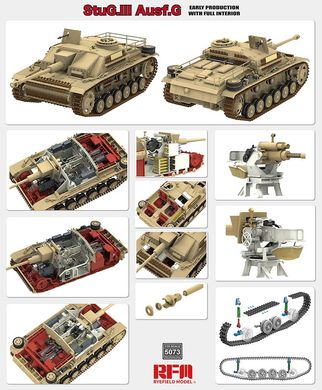
The main feature of the drivetrain is that these swingarm torsion bars can be neatly glued in line with cast Nupsi, but if you want a flexible suspension, just remove the Nupsi on the tray and you have a flexible suspension. But that's not all, because unlike other manufacturers who have moving torsion bars but then add bonded single-link chains or the unpopular vinyl/DS chains, here at Rye Field we have moving single-link chains. Excellent quality individual chain links with clean casting, good details and no drop points! The chain links are inserted using two small bolt heads on the right and left, keeping the chain links moving - definitely a tricky job and not guaranteed for beginners. The wheels are great too. Welds, wheel nuts and rim holes, and especially the manufacturer's imprint on the rubber rims are well represented - even if the last letter was changed by the manufacturer for licensing reasons. The upper hull cover consists of three parts: the glacis plate, the casemate and the engine deck, which has very nice thin welds around the edges. Extremely beautiful polyethylene grilles with fine engraving are included in the fan grilles. All hatches, whether in the Glacis plate, superstructure, or engine deck, can be opened or closed—which makes sense here, because with a full interior, you can finally see something through the open hatches.
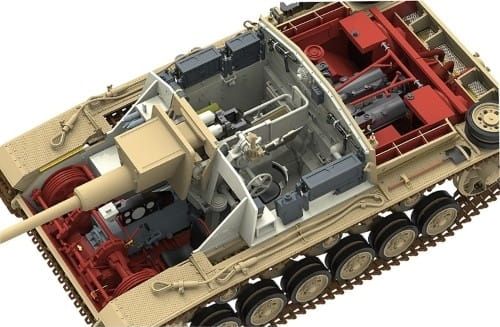
The individual chain guards are really well designed with a slim lug profile which is really impressive at this scale. Most of the components in this kit can be attributed to the interior design, which seems to include everything, really everything - from the detailed bath floor with torsion bars, brackets and racks to the ammunition storage, gearbox, driver's area with fittings, to the complete engine compartment and casemate equipment with gun parts, sighting and aiming equipment, and small parts such as small arms and accessories.
It's all extremely pleasing thanks to the truly excellent quality of the injection molding. Of course, the gun can be mounted vertically and sideways, and the barrel is a single piece of plastic. A great muzzle brake is simply multi-part, as the inner guide ring and front end plate only need to be attached.
Although the box lid shown is for this early version, which comes in good quality - if you like conversions or for a litter box, there is also a slim lid for the pig's head. It's great that Raifield thought of the engine deck "fence" often seen on StuGs to keep the material being transported from sliding off. This is quite attractively presented in 3 die-cast parts. Very well structured and detailed assembly instructions in typical RFM style lead to the goal with large and clear drawings in 51 construction steps. There should be no ambiguity here - you just need to be sure about the options you want to use. There are always colored components between them for better viewing so that any ambiguities can be reduced. At the end of the assembly instructions there is only one color page with 3 color profiles for painting and marking - and here you get the impression that the model needs to be brought to the market quickly, since on the one hand the color profiles are only shown on one page, and not as usual in 4 or even 5 page views, followed by 3 completely blank pages. This is a bit sub-optimal, but not a real problem for the crafty modeler.
Marking options are shown: "Tiger Shark", StuG Abt.202, 1944, Ukraine in typical three-color camouflage
Alligator, StuG Abt.202, summer 1943, Ukraine in typical three-color camouflage
"Crake", StuG Abt.202, 1943, Ukraine in typical three-color camouflage