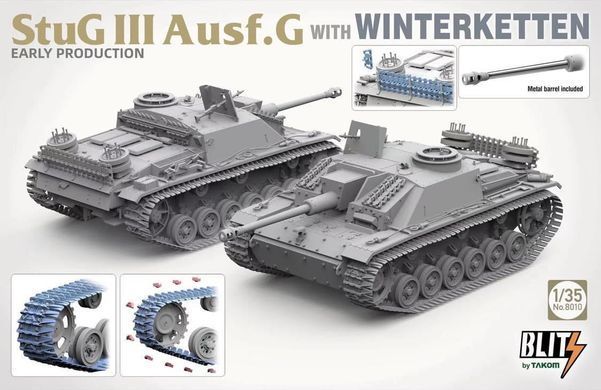
StuG III (Sturmgeschutz III) - German armored gun of the Second World War. The first prototypes of the machine were built in 1937, and serial production continued in the period 1940-1945, culminating in the release of about 10,300 machines. StuG III in the E version was equipped with one Maybach HL 120 TRM engine with a capacity of 300 hp. It was armed (version E) with a 75 mm short-barreled gun and one 7.92 mm MG34 machine gun.
StuG III was created as a result of the initiative of Erich von Manstein, who in a letter to General Beck in 1935 signaled the need to create assault artillery for the advancing infantry as part of the mechanized units of the Wehrmacht. Ultimately, the order for the design of the new machine was entrusted to Daimler-Benz, which, in turn, used the chassis of the PzKpfw III Ausf. B. During serial production, several versions of the StuG III gun were produced. Chronologically, the first was version A, armed with a 75 mm Stuk 37 L/24 gun and based on the chassis of the PzKpfw III Ausf. F and G tanks, which had been produced since early 1940. Shortly after, version B was created - the first to be produced on a large scale, which differed only slightly from version A. In 1941, version D entered production, which had better armor and sights. Version E was quickly created, which was the first to receive additional armament in the form of an MG34 machine gun. In early 1942, the StuG III underwent significant modification to effectively become a tank destroyer, with the installation of the long-barreled 75 mm StuK 40 L/48 gun. The vehicle's designation was also changed to StuG 40. Between 1940 and 1945, the StuG III saw service on almost every front the German army fought on. It proved to be a very useful weapon, cheap to produce and, most importantly, effective. It is estimated that various versions of the StuG destroyed approximately 20,000 Soviet tanks and armored vehicles between 1941 and 1945.